Rosacea is one of the most common but misunderstood skin conditions we see at Plump. It's often mistaken for sensitivity, barrier impairment, perioral dermatitis, acne, or a permanent flush, because it looks different on every person and cycles in response to a range of internal and external triggers. Depending on its severity, the skin can even respond to an acne treatment without actually being acne. Because of all this, it can take years before rosacea is properly assessed and diagnosed. So it makes sense that we all need a little more education, and this guide is a starting point. It won't replace a clinical assessment, but it will give you a clearer picture of what rosacea is, how to recognise your own version of it, and what actually helps.
What is rosacea
More than a blush.
Rosacea is a chronic inflammatory skin condition. It primarily affects the central face (the cheeks, nose, chin, and forehead) and involves a combination of vascular dysfunction, immune dysregulation, and, in some cases, a disrupted skin barrier.
It is not caused by poor skincare habits. It is not something you can simply grow out of. And it is not the same for everyone, which is exactly why understanding your specific subtype and your individual triggers matters so much.
Nurse Caitlin's note: “Rosacea sits at the intersection of the skin, the nervous system, the gut, and the immune response. Treating only what's visible on the surface gets results, but understanding what's driving it gets long-term, best-skin results.”
The four subtypes
Which type are you?
Rosacea is classified into four main subtypes. Many people present with features of more than one, and your subtype can shift over time, particularly if left unmanaged.
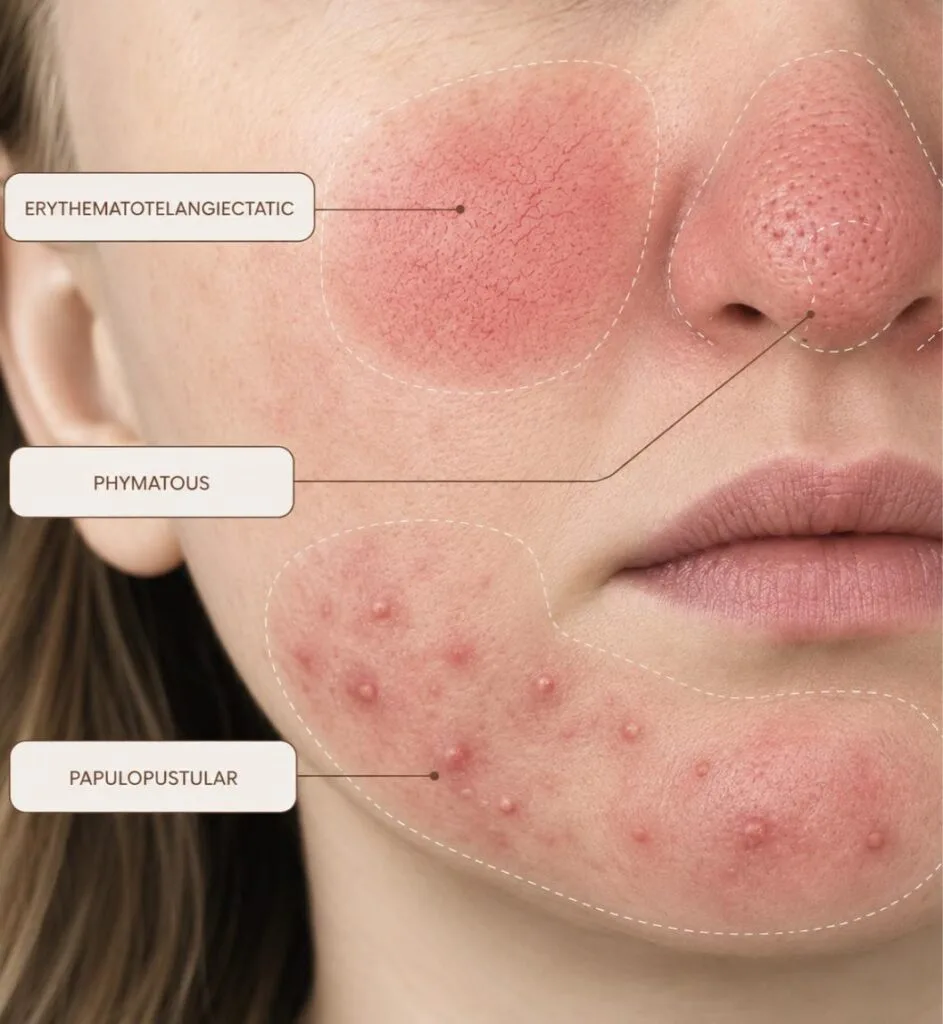
Three of the four subtypes shown… Ocular rosacea affects the eyes and eyelids and often occurs alongside the others.
1. Erythematotelangiectatic (ETR). The most common subtype. Characterised by persistent redness and visible broken capillaries, often with episodes of flushing. Skin may feel hot, tight, or reactive. Signs: central facial redness, visible vessels, burning or stinging, easy flushing.
2. Papulopustular. Often confused with adult acne. Involves breakouts (red bumps and pus-filled spots) alongside persistent background redness. Unlike acne, there are no blackheads or whiteheads. Signs: red bumps, pustules, central redness, no comedones.
3. Phymatous. Less common. Involves skin thickening, most notably on the nose (rhinophyma). More common in men, though women can develop milder forms. Often develops from long-standing ETR. Signs: thickened or textured skin, enlarged pores, irregular surface.
4. Ocular. Affects the eyes and eyelids. Can occur independently of skin symptoms or alongside other subtypes. Frequently underdiagnosed. Signs: dry, irritated, or gritty eyes, redness at eyelid margins, sensitivity to light.
Rosacea across your life
How it changes as you do.
Rosacea rarely announces itself clearly. Most people experience a slow progression: a flush that takes longer to settle, a cluster of breakouts that won't resolve, a persistent redness that skincare alone can't shift. Understanding where you are in that progression matters.
20s and early 30s. Rosacea in this decade is often mistaken for reactive skin or acne. You may notice your skin flushes easily (after exercise, alcohol, or a warm room) and takes longer to settle than it used to. Papulopustular rosacea often begins here, particularly in women around hormonal shifts.
Mid 30s to 40s. This is when rosacea often becomes harder to ignore. Background redness may become more persistent, visible capillaries more apparent. Hormonal transitions (perimenopause, post-pregnancy, thyroid changes) can amplify symptoms significantly. Skin may feel increasingly reactive to products that were previously well-tolerated.
50s and beyond. With reduced oestrogen and a naturally thinning skin barrier, rosacea can intensify. Flushing may occur with less provocation, and the vascular component often becomes more pronounced. This is also the decade where previously mild rosacea can progress to phymatous changes if it hasn't been actively managed.
Seasonal patterns
Why your skin behaves differently through the year.
Rosacea is highly responsive to environmental conditions. Many people notice a clear seasonal rhythm, and recognising yours is one of the most useful things you can do.
Summer. Heat, UV exposure, and humidity are among the most potent rosacea triggers. Flushing intensifies, breakouts may worsen, and even gentle exertion outdoors can provoke a flare. Broad-spectrum SPF is non-negotiable (zinc-based formulas are even better), but many traditional sunscreens further irritate compromised skin, so formulation matters. It can be frustrating to buy something and not be able to use it, and that's where consulting a dermal professional saves you time, money, and heartbreak. We've done the research, so you can trust our advice. Our only goal is to guide you toward your healthiest, most vibrant skin.
Autumn. Often a settling period. Temperatures drop, UV is lower, and many people find their rosacea calms. This is a good time to begin active treatment, because skin is more receptive and less reactive.
Winter. Cold air, wind, and central heating create a different type of stress. The barrier is challenged by dehydration and temperature extremes: moving from cold outside to heated indoors triggers flushing in many people. ETR rosacea often worsens.
Spring. Warming temperatures and increased sun exposure can prompt a return of summer-like flares. Pollen and environmental allergens may also amplify the inflammatory response in sensitive skin.
Understanding your triggers
No two rosacea skins are the same.
Rosacea triggers are highly individual. What causes a significant flare in one person may have no effect in another. The most commonly reported triggers include:
Environmental: sun exposure and UV; wind, cold air, and rapid temperature changes; high humidity; pollution.
Dietary: alcohol (particularly red wine); hot drinks; spicy foods; histamine-rich foods such as aged cheeses, fermented foods, and processed meats.
Internal: hormonal fluctuations (menstrual cycle, perimenopause, thyroid); gut imbalances such as dysbiosis, low stomach acid, or candida overgrowth; chronic stress and cortisol elevation; dehydration.
Topical: alcohol-based toners or astringents; fragrance and essential oils; physical exfoliants; some chemical sunscreen filters.
Lifestyle: intense exercise; hot showers or baths; saunas or steam rooms; sleep deprivation.
Identifying your pattern. Most people with rosacea have two to four consistent triggers, but many don't know what they are because they've never tracked them. Keeping a simple record of flares, what preceded them, and how quickly they resolved is one of the most clinically useful things you can do before your first consultation.
A tool worth knowing: the Rosacea Diary app. The Rosacea Diary app is a practical resource for tracking your skin day to day. It lets you log flares, note potential triggers, observe patterns across time, and build a picture of what your rosacea actually responds to, rather than guessing. Used consistently, it can reveal patterns that aren't obvious in the moment: a food you eat regularly that correlates with breakouts three days later, a week of poor sleep before a significant flare, a seasonal shift you hadn't consciously registered. Important: the Rosacea Diary is a support tool, not a treatment plan. The data it generates is most valuable when reviewed in the context of a professional assessment. Self-tracking can identify patterns, but interpreting what's driving them, and what to do about it, is clinical work.
How we treat rosacea at our Melbourne clinic
Skin and system, together.
At Plump, we don't treat rosacea as a purely cosmetic problem. We treat it as a condition that lives in the skin and is driven by what's happening beneath it.
On the skin:
Medical-grade skincare: prescribed to your subtype and barrier state. An important step for supporting the inflammation and barrier impairment, and for ensuring a stable, day-to-day minimisation of flares. Support, treat, maintain, and prevent.
LED therapy: anti-inflammatory, calming, and barrier-supportive. It stimulates ATP to accelerate healing and improve cellular function, helps minimise the vascular inflammation cascade (telangiectasia), and helps control pustular formation.
Chemical peels: carefully selected, barrier-supportive formulations for appropriate subtypes only.
PDRN / prescribed-medication mesotherapy: delivered topically, via microbolus injection, or via skin needling once the skin is well-prepped; supports cellular repair and reduces the inflammatory response. Maintenance may include microbolus/meso-stamped anti-wrinkle injections for the correct subtype and presentation.
SkinPen microneedling with PDRN or prescribed medications: for stable, well-conditioned skin; not a starting point, but a meaningful step-up.
IPL: supports the more severe to subacute stages, for persistent flushing or as a results-driven treatment that reduces the vascular component and the subsequent inflammatory load; it breaks down visible capillaries and reduces diffuse redness. (Results supported by clinical research.)
From the inside out: naturopathy. Our naturopath Alida approaches rosacea as a systemic condition, not a skin problem that happens to show up on the face. The redness, heat, and reactivity you see on the surface are often the body's way of signalling that something deeper is driving chronic inflammation, and that is the layer she works to understand. Rather than treating the flushing alone, she investigates the root causes that can sit underneath a rosacea picture. Gut health is often central to this. When the gut microbiome is out of balance (dysbiosis, candida overgrowth, or a parasite burden), the body can sit in a state of low-grade inflammation that keeps showing up in the skin. Low stomach acid plays a role too, because when food isn't being broken down and absorbed properly, it can feed that same inflammatory cycle and leave the body under-nourished in the nutrients skin relies on. From there she looks at the wider systems that influence how reactive the skin becomes. Hormone imbalance can drive flushing and sensitivity, and stress physiology is almost always part of the conversation, because a nervous system stuck in a heightened state keeps the body inflamed and the skin on high alert. By identifying which of these drivers are at play for you and working to address them, the aim is to calm inflammation at its source. For many people, this internal work is the piece that shifts rosacea from something they're constantly managing on the surface to something that feels genuinely more settled. This is why our approach is never just skin deep.
Omegas and DHA. Omega-3 fatty acids are one of the most well-regarded nutrients for supporting inflammatory skin, and rosacea is no exception. Omega-3s, DHA and EPA in particular, are known for their anti-inflammatory properties. Because rosacea is driven by inflammation, supporting the body with adequate omega-3 intake may help calm some of that internal reactivity rather than only addressing it on the surface. They also play an important role in the skin barrier: a stronger, better-supported barrier tends to be more resilient, which matters a great deal for skin that flushes and reacts easily. There's also growing interest in the link between omega-3s and tear film quality, relevant for the many people who experience ocular rosacea and the dry, gritty eye symptoms that can come with it. As with everything in Alida's approach, the goal isn't simply to add a supplement but to understand whether your intake is actually supporting you, and to make sure it's the right form and quality to make a difference.
Why quality matters. The supplements on a supermarket or pharmacy shelf are often formulated at lower doses, in less bioavailable forms, and without the same standards of testing and purity. For a nutrient to genuinely support an inflammatory condition like rosacea, it needs to be well formulated, well absorbed, and taken at a therapeutic level. This is why we stock a practitioner-only range, available in clinic, held to a higher standard of quality, potency, and ingredient integrity, and prescribed based on what your body actually needs. Alongside our practitioner-only omegas, two others are worth mentioning. Collagen is one of the building blocks of healthy, resilient skin; a well-supported skin structure and barrier tends to cope better with the things that aggravate rosacea. Magnesium is a beautiful one for rosacea, because so much of the condition is tied to stress and the nervous system. It supports the body's stress response, easing tension and supporting better sleep and regulation. When the nervous system is calmer, the skin often follows.
Lymphatic drainage and rosacea. Rosacea is an inflammatory condition, and a lot of what drives it sits beneath the surface. Internal triggers like stress and ongoing inflammation can place real strain on the lymphatic system; when the body is under pressure, that system can become sluggish and struggle to move fluid and clear waste effectively. When that slows, fluid can hold heat and contribute to congestion around an already sensitive vascular system, which may add to the flushing, redness, and reactivity of a rosacea picture. Using light, rhythmic movements, lymphatic drainage encourages stagnant fluid to move through the pathways again, helping release trapped heat and ease congestion, so the skin can feel calmer, cooler, and less reactive. Because so much of the condition is tied to stress, the slow, rhythmic nature of the treatment also helps bring the body into a more regulated state, which is exactly the environment reactive skin needs to settle. Used around known flares and triggers (a richer meal, a few wines, a stretch of high stress), a session becomes part of how you manage your triggers rather than something you reach for once the damage is done.
Ready to understand yours?
Book a consultation at Plump to begin managing and supporting your rosacea. Our experienced team of dermal clinicians and nurses will thoroughly assess your skin, lifestyle, and overall health, and prescribe homecare or build an in-clinic treatment plan around your specific subtype and triggers. If you want to go deeper, to understand what's driving your rosacea from the inside, a naturopathy consultation with Alida is where that conversation begins. Lymphatic drainage massage is also offered by Alida, who is both a naturopath and a lymphatic specialist, the perfect support for the lymphatic load that conditions like rosacea carry.
This guide is intended for educational purposes only and does not constitute medical advice. Individual skin concerns should be assessed by a qualified clinician.
Plump Aesthetic Clinic acknowledges the Wurundjeri Woi-wurrung people of the Kulin Nation as the Traditional Owners of the land on which we live and work, and pays respect to Elders past, present and emerging.
Plump is a safe and welcoming space for people of all cultures, bodies, abilities, genders and sexualities.