What is actually driving adult acne, and the right order to deal with it.
Most people who come to see us about acne have already tried a lot. Different cleansers. Something stronger from the pharmacy. A stretch of stripping the skin back to almost nothing. A few have been told to simply wait it out, and some were told that at fifteen and are now thirty two, still waiting.
If that is you, here is the first thing worth saying. You are not doing it wrong, and you have not failed at washing your face. Acne is a condition of the hair follicle and the oil gland attached to it. It is influenced by hormones, inflammation, barrier function, the skin’s own microbiome, genetics, stress, and in some cases what is happening in the gut. It responds well to treatment when the treatment is matched properly. It responds poorly to guesswork.
This post is the short version: what is likely going on, and where to start. If you want the long version, we have written one, and there is a link to it at the end.
Adult acne is its own condition
The most common mistake is treating adult acne as though it were teenage acne that overstayed its welcome. It is not the same thing, and the difference matters.
Adult acne affects women far more often than men. It tends to sit along the jawline, chin, and lower cheeks. It is more inflammatory and less comedonal, which means fewer blackheads and more of the deep, sore lesions that take weeks to resolve and are more likely to leave a mark. It often follows a cycle, flaring in the week or two before a period.
There is a physiological reason it lands where it does. The lower face carries the highest density of androgen receptors on the face, so that area responds more strongly to hormonal fluctuation than your forehead or nose does.
And here is the part most people are never told: you can have completely normal blood test results and still have hormonally driven jawline acne. The sensitivity often sits at the follicle itself rather than in your circulating hormone levels. Normal bloods do not mean you imagined it.
The practical consequence is that adult skin cannot be treated with a teenage protocol. Barrier function, hydration and collagen are all changing at the same time. Treat adult acne like teenage acne and you may clear some breakouts while dehydrating and ageing the skin underneath. The plan has to address acne and skin quality together, because at this age they are the same conversation.
Why timing makes it so hard to judge
One piece of biology explains most of the frustration people feel.
The pimple you can see today began forming in that follicle somewhere between two and eight weeks ago. Treatment is not working on what is on the surface. It is working on what has not surfaced yet.
That has two consequences worth holding onto. The first is that a breakout arriving the week before your period did not necessarily start there. What surfaces premenstrually often began developing in the previous cycle, and the hormonal shift is frequently what pushed it through rather than what caused it.
The second is about how you measure progress. If you menstruate, comparing your skin in week two to your skin in week four tells you very little, because you are comparing two different hormonal environments. Comparing the same point in two consecutive cycles tells you a great deal. This is why we assess at eight to twelve weeks rather than at two, and why a flare in your premenstrual week is not evidence that a plan has failed. It is evidence that you have a cycle.
Are you sure it is acne?
Not every breakout is acne, and treating the wrong condition for months is how people lose a year.
Rosacea is the one worth ruling out first, because treating it as acne makes it considerably worse. Papulopustular rosacea produces red bumps and pustules that look, at a glance, exactly like inflammatory acne. The distinguishing feature is comedones. If you have red bumps but no blackheads or whiteheads anywhere, that is a significant clue. Rosacea also sits on a background of persistent central redness, usually comes with a history of flushing, and tends to burn or sting rather than feel sore. Its triggers are environmental rather than hormonal: heat, sun, alcohol, spicy food, temperature change, exercise, stress. We have written a full guide to rosacea if that sounds like you.
Fungal acne, properly called Malassezia folliculitis, presents as small, uniform, often itchy bumps clustered on the forehead, hairline, chest or back. It is driven by a yeast rather than acne bacteria, which is why it does not respond to standard acne treatment and can be made worse by it.
Perioral dermatitis has its own pattern, clustered around the mouth, nose or eyes, often sparing a thin border right at the lip line.
If you have been treating acne for months with nothing to show for it, the diagnosis is the first thing worth questioning.
When it needs a doctor rather than us
We want to be straightforward about where our scope ends.
If your acne is deeply cystic, scarring quickly, or has not responded to appropriate treatment, that needs medical review with a GP or dermatologist. Prescription options exist that we cannot provide, and for the right person they are the right answer.
This matters more than it might sound, because cystic acne scars structurally. The damage happens in the dermis, where collagen is destroyed rather than simply inflamed, and that kind of scarring does not fade with time or with skincare. Every month of untreated cystic acne is scarring that cannot be recovered later. Cystic acne treated at month three has a very different outcome to cystic acne treated at year three.
So if that is what we see, we will tell you plainly and help you get to the right person. We are not going to sell you a course of peels for a condition that needs medicine. What we can do is work alongside that treatment, supporting the barrier while the skin is dry and fragile, calming inflammation, and planning the scar work for once the acne itself is controlled.
The internal picture, and where Alida comes in
Acne is a skin condition, but the drivers are not always sitting in the skin. When someone has done everything right topically and is still breaking out cyclically, or when acne arrives alongside digestive symptoms, fatigue or hormonal change, we look further.
Alida is our naturopath. Her approach is investigative rather than prescriptive: rather than treating acne as a standalone complaint, she looks at digestion, cycle patterns, stress load, sleep and nutrition, and works to identify what may be contributing in your individual case. Her focus areas include gut function, hormonal balance, the physiological load of stress, and inflammation more broadly.
There is one situation where this work is particularly worth knowing about, because the timing changes everything.
If you are thinking about coming off the pill
Post-pill acne affects close to half of women who stop hormonal contraception, typically flaring somewhere between three and six months afterwards. For some it settles within a few months. For others it persists for a year or longer, particularly when the underlying drivers were never addressed.
The cruel irony is that acne is often why many women started the pill in the first place. The pill does not fix the problem. It suppresses the hormones driving it. When it stops, those hormones return, often harder than before, and the skin has no backup plan.
There are specific, identifiable reasons this happens: androgens returning all at once to a skin that has not had to manage them in years, a gut microbiome altered by synthetic hormones, a liver suddenly processing hormones it was not trained for, and depletion of the exact nutrients skin cells rely on to regulate oil, manage inflammation and turn over healthily.
The useful part is that all of that can be addressed in advance. Alida generally starts naturopathic support two to three months before you stop, rather than waiting for the flare to arrive. Alida and Caitlin have written about this properly in a separate piece, and if coming off the pill is on your horizon, that is the one to read next.
This is complementary care, designed to work alongside your skin treatment plan and any medical care you are receiving, rather than replacing either. We are careful not to promise that internal work will resolve acne on its own, because that depends entirely on what is driving yours.
Alida also offers lymphatic drainage
Worth mentioning because it sits naturally alongside the above. The lymphatic system is how the body clears inflammatory by-products and excess fluid, and lymphatic drainage is a light, rhythmic, deeply calming technique that supports that process. For acne-prone skin, people often find it helps with facial puffiness and congestion. Alida also offers remedial face and TMJ release, which is useful for anyone holding tension through the jaw, which is exactly where adult hormonal acne tends to concentrate. If you would like the detail, we have written about what lymphatic drainage actually does.
So where do you actually start?
Start with an assessment, not a product.
We say that knowing how it sounds coming from a clinic, so here is the honest reasoning. Acne skincare is not a pick and mix. The same active that clears one person’s congestion will inflame the next person’s barrier, and the difference between those two outcomes is not something anyone can work out from a video, a quiz, or a page like this one. Every week we see skin that has been made considerably worse by a routine assembled from perfectly good products, used in the wrong combination, at the wrong strength, on the wrong skin.
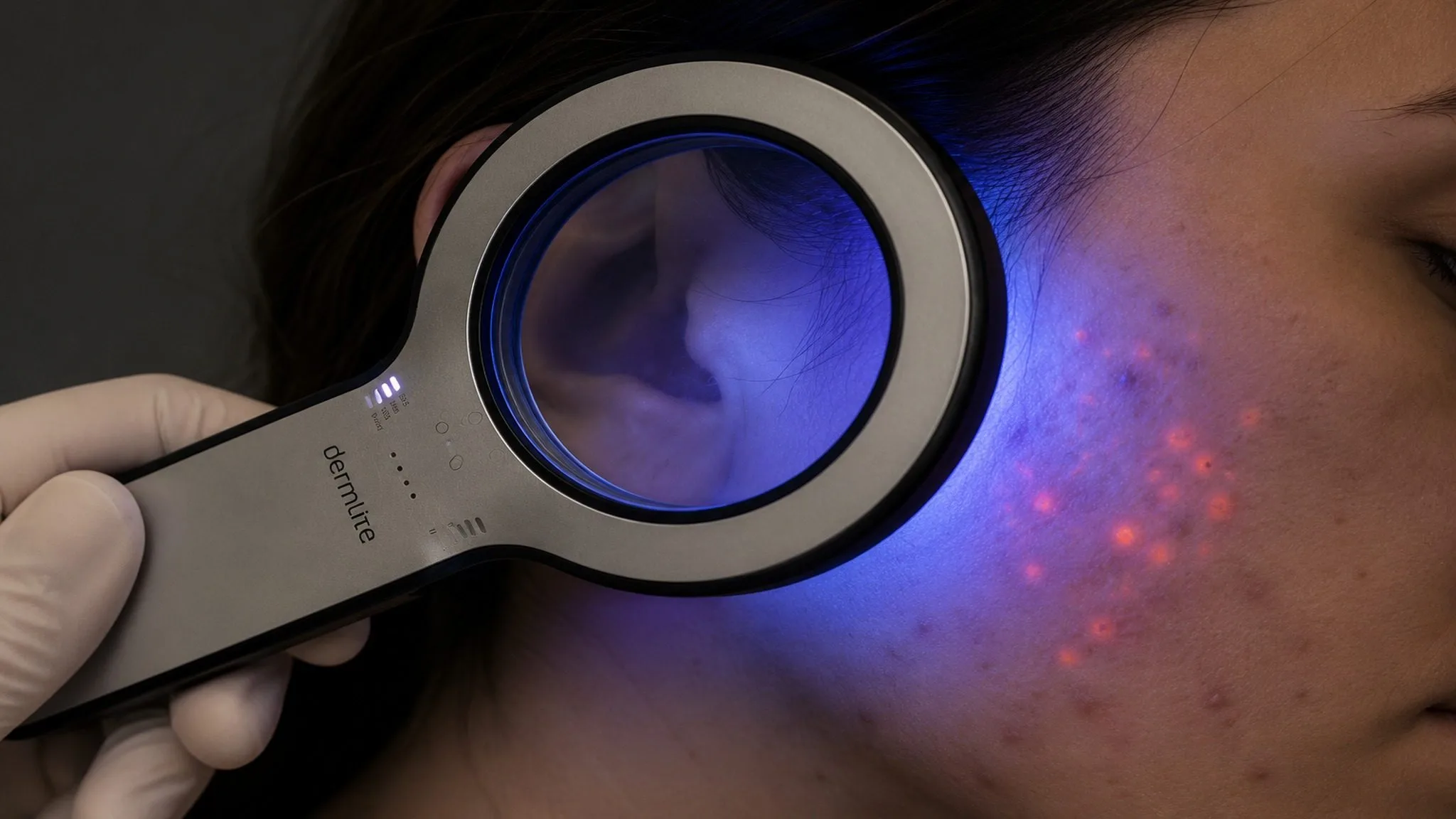
In clinic we look at your skin in person and in real time. We use a Wood’s lamp, a specialised UV light that reveals congestion, oil distribution, bacterial activity and pigment sitting beneath the surface where the naked eye cannot see it, and a dermatoscope to examine individual lesions under magnification. That shows us what is genuinely happening inside your skin rather than what it looks like from the outside.
Under UV light, bacterial activity and congestion fluoresce beneath the surface. This is what we are looking at in a consultation, rather than what the skin looks like from the outside.
It usually saves money too. Most people who walk through our door have already spent several hundred dollars on products that were never going to suit their skin. One consultation and a correctly built routine costs considerably less than a year of guessing.
Then expect the plan to run in a sequence. Broadly: barrier repaired and home care simplified first, gentle in-clinic work to calm rather than provoke, then progression as tolerance builds, and only once the active acne is controlled do we turn to what it left behind. That order is not negotiable. Needling or resurfacing inflamed skin produces more scarring and more pigment, not less.
And if scarring is your main concern, the same principle applies in reverse: the acne has to be controlled first, and then scar type determines everything. Rolling scars are tethered from below and need releasing before anything else will work on them. Boxcar scars respond to collagen stimulation. Ice pick scars need a focal approach. Most faces carry three or four types at once. That is a proper assessment conversation, and we have a dedicated page on acne scarring for it.
A few things worth stopping now
Over-exfoliating. Layering multiple strong actives. Scrubs. And picking, which converts a mark that would have faded into a scar that will not.
Also worth retiring: the idea that if it stings, it is working. Stinging is irritation, irritation is inflammation, and inflammation is the thing we are trying to reduce.
Read next
The full acne page. Everything above in considerably more depth: acne across every life stage, your cycle and your skin, pregnancy and postpartum, back and chest acne, every treatment we offer and the evidence behind it, costs, and the myths we correct every week.
Coming off the pill. Alida and Caitlin on why skin struggles post-contraception, and what to do in the two to three months before you stop.
Acne scarring. Scar types, sequencing, and what actually works on each.
Every acne plan at Plump begins with a full consultation. We assess your skin properly, discuss your history, medications and lifestyle, explain what we believe is driving your breakouts, and build a plan with realistic expectations and clear timelines.
There is no cost and no obligation. If budget is a constraint, tell us. We would rather build a smaller plan you can actually complete than an ideal one you abandon at week six.
Results vary between individuals and depend on skin type, acne severity, underlying contributing factors, home care and the plan followed. No result is guaranteed. All treatments carry risks, which will be explained in full before you proceed. This information is general in nature and is not a substitute for individual medical advice. If your acne is severe, painful or scarring, please seek review from your GP or a dermatologist.
Plump Aesthetic Clinic acknowledges the Wurundjeri Woi-wurrung people of the Kulin Nation as the Traditional Owners of the land on which we live and work, and pays respect to Elders past, present and emerging.
Plump is a safe and welcoming space for people of all cultures, bodies, abilities, genders and sexualities.